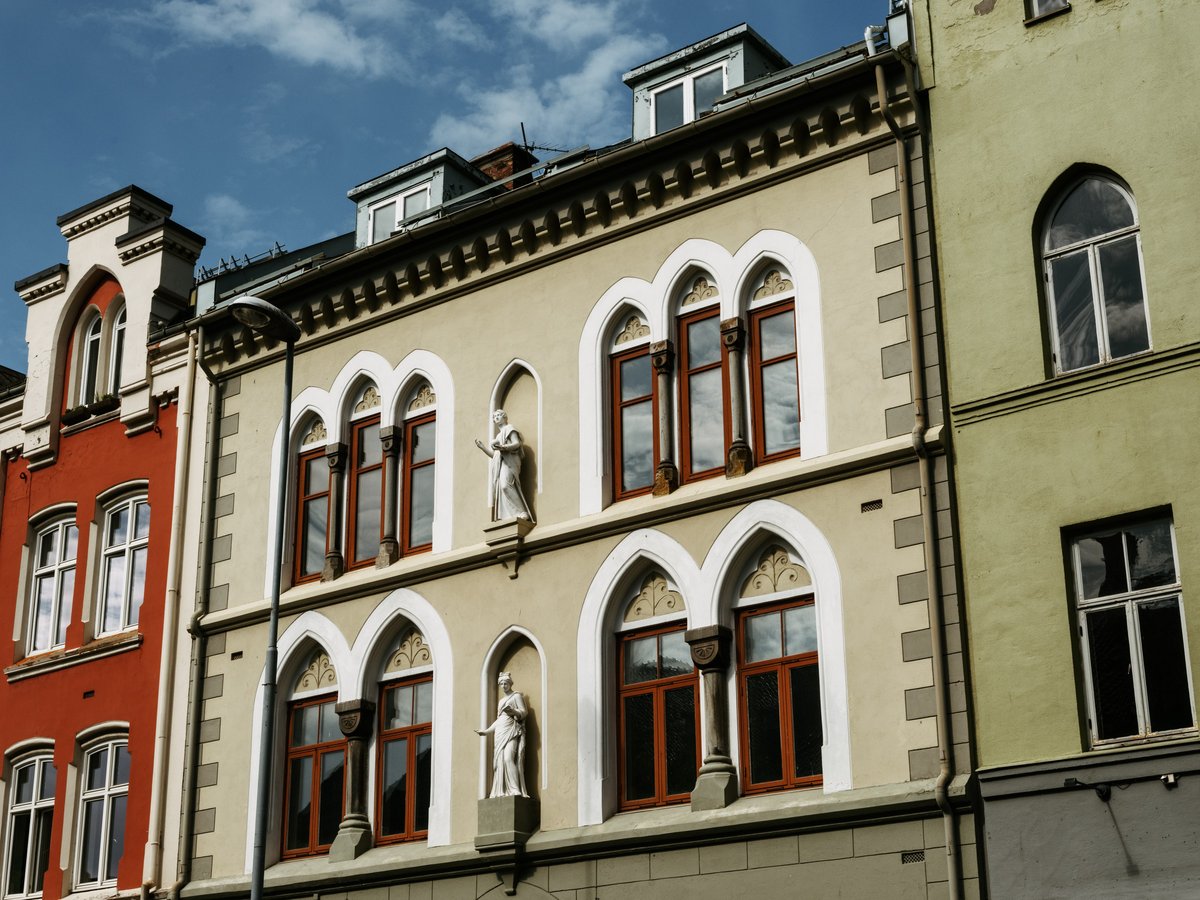
If you pause on the sidewalk outside Villa Nord and look up, you are met by plastered masonry, elegant pointed arches, and three rows of tall windows. In the niches of the neighboring building, two of Homer's nine muses stand as silent guardians. Today, the villa exudes a deep, yet hard-won tranquility. Twice our street has fallen to fire, and twice new buildings has risen. Through all the years and all the drama, these walls have always been defined by the hands of its people. Some have made beds for travelers, while others have prepared the meals. Now, it is our turn.
The advertisement from 1837
In April 1837, the tradesman Arnt Flengstad informed newspaper readers in Trondheim that he held "Table d'Hôte," served "Carte," and welcomed travelers. That same year, he had married Ingeborg Kirstine Røst, and Hotel du Nôrd in Fjordgata became the couple's new business. The first guest registered on May 2, a chaplain from Grong. After him came magistrates and chamberlains, a Swedish count, German estate owners, and the first British salmon fishermen. The city already had ten farmer lodgings for travelers, but this was the first to be referred to as a hotel. London publisher John Murray gave the hotel its own entry in his 1838 travel guidebook.
«Trondhjem. Inns: The Hôtel du Nord was opened in 1837. There are plenty of comfortable lodging-houses.»
John Murray, A Hand-book for Travellers in Denmark, Norway, Sweden, and Russia
Onwards to Dronningens gate
Arnt Flengstad put his hotel dream on hold in 1839, when the newly opened "Hotel d'Angleterre" took over as the city's premier hotel. Flengstad continued running his tavern in Fjordgata, but simultaneously purchased Dronningens gate 26, which at the time housed "Madame Barboe's lodgings," and relocated his accommodation business there.
Then disaster struck. The great city fire of April 24, 1841, reduced large parts of Trondheim's east side to ashes. A storm was raging, and the fire spread mercilessly. 330 properties and 40 wharves were lost, 2,000 people were left homeless, and an unfortunate maid had to serve six months in prison for carelessness with fire.
But Arnt saw new opportunities. On the site of the fire, at the corner of Dronningens gate and Jomfrugata, he erected a new building to house both his growing family, which eventually numbered four children, and the city's visitors. When Arnt passed away at the age of 48 after 12 days of illness, Ingeborg took the helm. She continued to run the building and the business with a steady hand.
Sweet music in the hallways
In 1854, a young piano maker from Romsdal, Mads Jansen, took lodgings with widow Flengstad. He built and tuned pianos, and by 1858 he not only had new instruments for sale, but also took on apprentices in the trade. Perhaps sweet music arose in more ways than one, for in time he married Arnt and Ingeborg's daughter, Julie. One of his instruments, beautifully carved with two lyres and stamped with "Pianoforte-Fabrik, Trondhjem," remains in the historic collection Ringve Music Museum.
Ingeborg continued running the inn undeterred. When Trondheim prepared for the coronation of Karl IV in Nidaros Cathedral in August 1860, she once again made sure the beds were made for prominent guests.
Rise of the neo-gothic quarter
In 1879, a fire broke out again in Dronningens gate, and the entire row from number 26 to 32 was lost. To prevent further disasters, the block was rebuilt in brick, and Trondheim's very first continuous masonry block became a reality.
The architects Johan Digre and Lars Solberg designed four three-story buildings in an elegant neo-Gothic style. Digre's building is the one you are standing in front of today, and it was in the neighboring building that the two muses took their place in the facade's niches. The new building contained seven apartments, and in 1888, the influential architect Karl Norum (1857–1911) was listed as a resident in one of them. Norum left a lasting mark, designing several of the city's most iconic buildings in Historicism and Art Nouveau styles, including the Britannia Hotel, Mathesongården, the Main Post Office (PoMo), the Customs House (Tollboden), the Masonic Lodge, and the now-demolished restaurant at the Hjorten pleasure gardens.
A hundred years of hotels
From 1895 Trondhjems Speil- og Møbelfabrikk, the largest furniture maker north of Dovre, kept its office, showroom and shop here while the factory itself worked out in Ila. Between the wars a private hotel and pension called Dronningen took the upper floors. Linnea Hotell & Restaurang opened in 1946 with twenty-nine rooms over three floors, run by the Hagen family. Dronningen Bed & Breakfast followed, and from 1990 Hotel Fru Schøller, which in 2007 bought the muses' house next door and grew into its upper floors. Fru Schøller closed in March 2026. Villa Nord takes the name of the hotel Arnt and Ingeborg opened in 1837, and it takes up their trade as well: a bed made for whoever comes.